

Ontario weather can be tough on vehicles. Drivers deal with freezing winter mornings, heavy snow, road salt, slush, spring rain, humid summers, stop-and-go city traffic, and long highway drives between cities. Because of these changing conditions, many drivers ask the same question: how often should you change oil in Ontario weather?
The honest answer is: there is no single oil change interval that fits every vehicle in Ontario. The correct interval depends on your vehicle manufacturer’s maintenance schedule, the type of oil your vehicle uses, your driving habits, mileage, engine condition, and whether your driving falls under normal or severe service conditions.
For many modern vehicles, the best starting point is always the owner’s manual or oil life monitoring system. However, Ontario drivers should also understand that cold starts, short trips, winter idling, stop-and-go traffic, towing, and extreme temperatures can make oil work harder. In those cases, the severe-service schedule may apply, which usually means oil should be changed more often than under ideal highway driving conditions.
If you are not sure what interval is right for your vehicle, book an oil change or maintenance inspection in Kitchener with Ironix Auto.
Why Oil Changes Matter
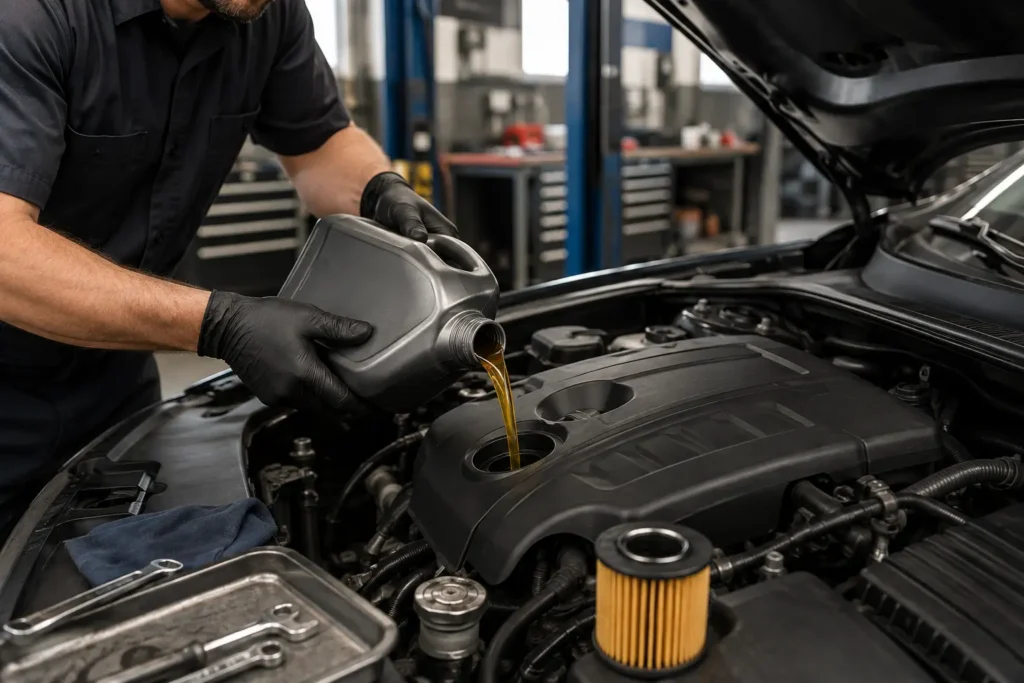
Engine oil does several important jobs. It lubricates moving parts, reduces friction, helps control heat, protects against wear, carries away contaminants, and helps keep internal engine parts cleaner.
Over time, oil breaks down. It can become contaminated with fuel, moisture, dirt, metal particles, and combustion by-products. The oil filter also has a limited capacity to trap contaminants. When oil becomes too dirty or degraded, it cannot protect the engine as effectively.
Skipping oil changes can lead to increased engine wear, sludge buildup, overheating risk, poor performance, reduced fuel efficiency, and in serious cases, major engine damage. Oil changes are one of the most basic maintenance services, but they are also one of the most important for long-term vehicle reliability.
The Most Accurate Answer: Follow the Owner’s Manual
Before choosing a fixed number like every 5,000 km, 8,000 km, 10,000 km, or 12,000 km, check your owner’s manual. Your vehicle manufacturer designed the engine and specifies the correct oil type, viscosity, filter requirement, and service interval.
Some vehicles use conventional oil, some use synthetic blend, and many newer vehicles require full synthetic oil. Some vehicles also have oil life monitoring systems that calculate oil life based on operating conditions.
A modern oil life monitoring system may consider factors such as engine temperature, driving time, speed, trip length, idle time, and operating conditions. When the system shows that service is due, do not ignore it.
However, if your vehicle does not have an oil life monitor, or if your driving pattern is harder than average, you may need to follow the severe-service schedule listed in your manual.

Why Ontario Weather Can Affect Oil Change Timing
Ontario’s climate is not the same all year. A vehicle in Kitchener may experience freezing winter mornings, hot summer traffic, spring rain, and fall temperature swings. These changes can affect how hard your oil works.
Cold Starts in Winter
Winter cold starts are hard on engines. When the temperature drops, oil flows more slowly until the engine warms up. The correct oil viscosity helps the engine get lubrication quickly, but cold starts still create extra stress.
This is why using the oil grade recommended by the manufacturer is important. Many modern engines require lower-viscosity synthetic oils that flow better in cold conditions. Do not guess the oil grade. Always use the grade specified for your vehicle.
Short Trips
Short trips are one of the biggest reasons Ontario drivers may need more frequent oil changes. If you drive only a few kilometres to work, school, the grocery store, or local errands, the engine may not reach full operating temperature long enough to burn off moisture and fuel dilution.
This can cause oil contamination over time. In winter, short trips are even harder because the engine takes longer to warm up.
A vehicle that is mostly driven on short local trips in Kitchener may need oil changes more often than a vehicle driven mostly on longer highway trips.
Stop-and-Go Traffic
City driving can be harder on oil than steady highway driving. Stop-and-go traffic, idling at lights, waiting in traffic, school drop-offs, delivery driving, and rideshare driving all increase engine running time without always adding many kilometres.
This matters because the odometer may not show the full stress on the engine. A vehicle that idles often may have oil aging faster than the mileage suggests.
Winter Idling
Many Ontario drivers idle their vehicles in winter to defrost the windshield, warm the cabin, or clear snow and ice. Some idling is normal, but excessive idling adds engine hours without adding kilometres.
Oil change intervals based only on kilometres may not reflect heavy idling. If your vehicle spends a lot of time idling, follow the severe-service maintenance schedule or ask a qualified technician for advice.
Road Salt, Slush, and Moisture
Road salt does not directly enter the engine oil under normal conditions, but Ontario winter conditions create a harsh environment for the whole vehicle. Slush, moisture, corrosion, and temperature swings can affect vehicle systems. Winter is also a good time to check fluids, leaks, belts, hoses, battery condition, tires, and underbody condition along with oil service.
Hot Summer Driving
Ontario summers can also be demanding. Hot weather, traffic, air conditioning use, long road trips, and towing can increase engine load and temperature. Oil must protect the engine under these conditions too.
If you tow, carry heavy loads, drive long distances in heat, or operate in dusty conditions, your vehicle may qualify for severe service.
Normal vs. Severe Driving Conditions
Many drivers think “severe driving” means racing, off-roading, or commercial work. In reality, many normal daily driving habits can fall under severe service.
Your driving may be considered severe if you regularly experience:
- Frequent short trips
- Repeated cold starts
- Stop-and-go city driving
- Long idling
- Very hot or very cold weather
- Towing or carrying heavy loads
- Dusty roads or construction areas
- Delivery driving
- Rideshare driving
- Taxi-style driving
- Frequent low-speed driving
- High-mileage driving
If this sounds like your routine, you may need oil changes more often than the normal schedule.
General Oil Change Guidance for Ontario Drivers
Because vehicles are different, the owner’s manual is the final authority. Still, the following general guidance can help Ontario drivers understand what is reasonable.
For Newer Vehicles With Synthetic Oil
Many newer vehicles using full synthetic oil may have longer manufacturer-recommended intervals than older vehicles. Some may recommend oil changes based on an oil life monitor rather than a fixed distance.
However, even with synthetic oil, severe driving can shorten the interval. Synthetic oil is better at handling temperature extremes and resisting breakdown, but it does not last forever. It still becomes contaminated and still needs to be changed with the filter.
For Older or High-Mileage Vehicles
Older vehicles may benefit from closer monitoring. Engines with higher mileage may have more wear, small leaks, oil consumption, or contamination. If your older car burns oil, leaks oil, or has a history of poor maintenance, do not stretch oil changes.
For high-mileage vehicles, check the oil level regularly between services. Running low on oil can damage the engine even if the oil itself is not yet due for replacement.
For Short-Trip City Drivers
If most of your driving is short trips around Kitchener, Waterloo, Cambridge, or nearby areas, your engine may spend a lot of time warming up and cooling down. This can be harder on oil than long highway driving.
Short-trip drivers should check the severe-service schedule in the owner’s manual. If your manual gives separate normal and severe intervals, the severe interval may be the safer choice.
For Highway Drivers
If you mostly drive longer highway routes and your vehicle reaches full operating temperature regularly, your oil may last closer to the normal manufacturer interval. Highway driving is often easier on oil than repeated short trips, because the engine runs steadily and reaches proper temperature.
Still, you should follow the time limit as well as the mileage limit. Oil changes are usually based on distance or time, whichever comes first.
For Rideshare, Delivery, or Fleet Drivers
Uber, Lyft, delivery, and fleet vehicles often operate under severe conditions. These vehicles may idle more, stop frequently, carry passengers or cargo, and accumulate engine hours quickly.
For these vehicles, oil changes should be planned carefully. Waiting only for high kilometre numbers may not be enough if the engine is running for long periods in city traffic.
Should You Change Oil Before Winter?
For many Ontario drivers, fall is a smart time to check oil and maintenance before winter. This does not mean every vehicle automatically needs an oil change before the first snowfall. It means you should check whether your oil change is due soon and confirm that the correct oil grade is being used.
If your oil is near the end of its service life, changing it before winter is practical. Fresh oil, the right viscosity, a good filter, and a basic winter vehicle inspection can help prepare your vehicle for cold starts and harsh driving conditions.
Before winter, it is also wise to check:
- Battery condition
- Coolant level and freeze protection
- Tires
- Wipers
- Washer fluid
- Lights
- Brakes
- Belts and hoses
- Fluid leaks
- Heating and defrosting performance
Oil service is only one part of winter readiness, but it is an important one.
Should You Change Oil After Winter?
Spring is also a good time for maintenance. After months of cold starts, idling, road salt, slush, and short trips, your vehicle may need service. If your oil change interval is due by time or kilometres, do not delay it.
Spring maintenance can also include brake inspection, tire changeover, alignment check, suspension inspection, underbody inspection, cabin air filter replacement, and checking for winter-related wear.
For Ontario vehicles, spring inspections are helpful because winter can hide or worsen issues such as leaks, worn suspension parts, corroded brake components, weak batteries, and damaged wipers.
Oil Type and Viscosity: Why It Matters
Oil viscosity describes how oil flows at different temperatures. You may see oil grades like 0W-20, 5W-30, 0W-30, 5W-20, or others. The correct oil depends on your vehicle.
In cold Ontario weather, the winter rating matters because oil must flow quickly at startup. However, you should not choose oil based only on weather or guesswork. Use the oil grade recommended in your owner’s manual or under the hood label.
Using the wrong oil can affect lubrication, fuel economy, engine performance, emissions systems, warranty coverage, and long-term reliability.
Synthetic vs. Conventional Oil in Ontario
Full synthetic oil generally performs better than conventional oil in extreme temperatures and can resist breakdown longer. Many modern vehicles require synthetic oil.
However, synthetic oil does not mean you can ignore maintenance. The filter still needs replacement, contamination still happens, and severe driving can still shorten the interval.
If your vehicle requires synthetic oil, use it. If your vehicle allows different oil types, ask a qualified technician what is appropriate based on the manufacturer specification, mileage, engine condition, and driving pattern.
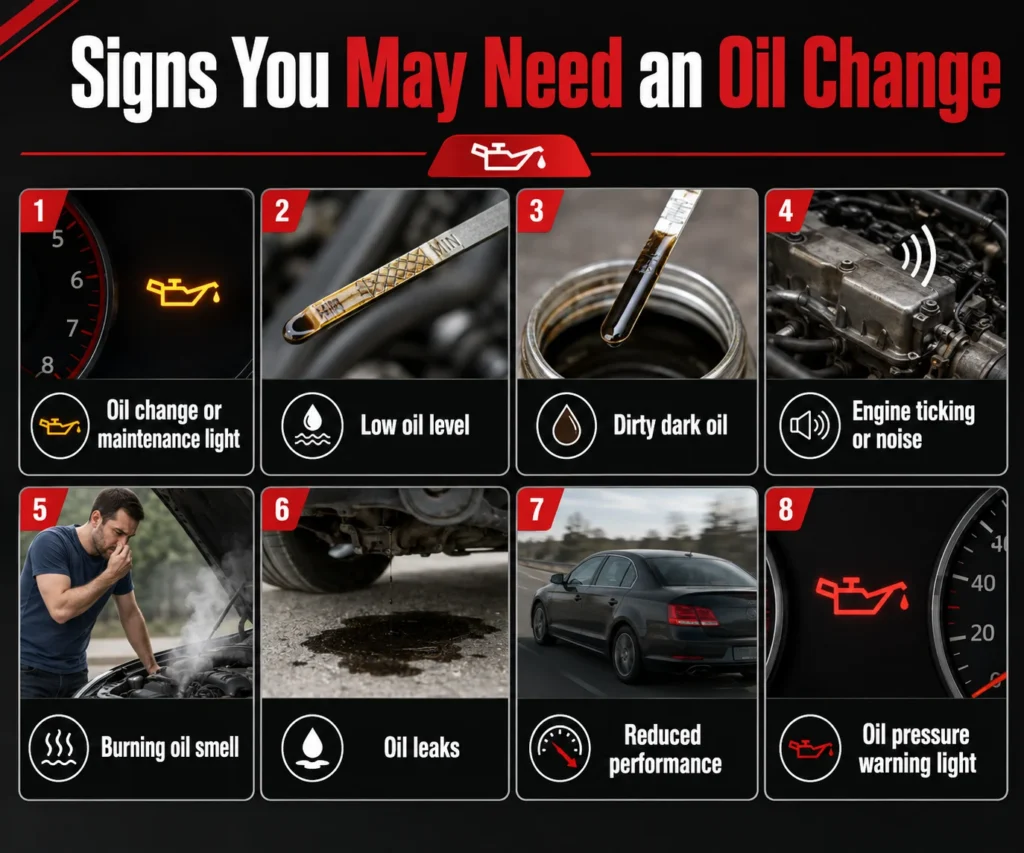
Signs Your Vehicle May Need an Oil Change
Do not rely only on mileage if your vehicle is showing warning signs. You may need an oil change or inspection if you notice:
- Oil change reminder or maintenance light
- Low oil level
- Dark, dirty oil
- Engine ticking or knocking
- Burning oil smell
- Oil leaks
- Reduced performance
- Excessive exhaust smoke
- Oil pressure warning light
- Unusual engine noise
- Poor maintenance history
If the oil pressure warning light comes on, stop driving as soon as it is safe and get help. Low oil pressure can cause serious engine damage.

Check Oil Level Between Services
Many drivers only think about oil at service time. In reality, it is smart to check oil level between oil changes, especially on older vehicles, high-mileage vehicles, turbocharged engines, and vehicles known to consume oil.
Check the oil level when the engine is off and parked on level ground. Follow your owner’s manual for the correct procedure. Some vehicles use a dipstick, while others use an electronic oil level system.
If your oil level is low, top it up with the correct oil type. If it keeps dropping, book an inspection for leaks or oil consumption.
Common Oil Change Mistakes to Avoid
Waiting Too Long
Stretching oil changes too far can increase engine wear and sludge risk. Even if the vehicle seems to drive fine, oil may be losing its ability to protect the engine.
Ignoring Time Intervals
Low-mileage drivers still need oil changes. Oil ages over time, especially with short trips, moisture, and fuel dilution. If you only drive a few thousand kilometres per year, follow the time interval in the owner’s manual.
Using the Wrong Oil
Using the wrong viscosity or specification can create problems. Always use oil that meets the manufacturer’s required grade and specification.
Replacing Oil Without the Filter
The oil filter traps contaminants. A proper oil change should include the correct filter unless the manufacturer procedure says otherwise.
Ignoring Leaks
If oil leaks are visible, do not just keep topping up. A leak can worsen and may cause low oil level, engine damage, or safety concerns if oil drips onto hot components.
Resetting the Oil Life Monitor Incorrectly
If your vehicle has an oil life monitor, it should be reset only after the oil has actually been changed. Resetting it without service can lead to overextended oil use.
How Often Should Kitchener Drivers Change Oil?
For Kitchener drivers, the best answer is:
Follow your manufacturer’s maintenance schedule, but consider the severe-service schedule if you drive mostly short trips, city traffic, winter idling, towing, delivery routes, rideshare, or harsh weather conditions.
If your vehicle has an oil life monitor, follow it, but do not ignore the owner’s manual’s time limit or annual oil change requirement where applicable.
If your vehicle is older, high-mileage, leaking, burning oil, turbocharged, or used heavily, ask a professional technician to recommend a safe interval based on your real driving pattern.
A practical maintenance routine for many Ontario drivers is to check oil level monthly, follow the vehicle’s oil life monitor or maintenance schedule, and service the vehicle before or after harsh seasonal changes if the interval is due.

Why Choose Ironix Auto for Oil Change in Kitchener?
Ironix Auto provides professional automotive repair, diagnostics, maintenance, and oil change services in Kitchener. A proper oil change is more than draining and refilling oil. It should include the correct oil, correct filter, basic fluid checks, leak inspection, and attention to manufacturer requirements.
Ironix Auto can help you choose the right oil based on your vehicle, mileage, and Ontario driving conditions.
Ironix Auto
1659 Victoria St N Unit 3
Kitchener, ON N2B 3E6
Phone: +1 519-744-8000
If you are not sure whether your vehicle is due for service, bring it in for an oil change inspection and maintenance check.
Final Answer
So, how often should you change oil in Ontario weather?
There is no single fixed interval for every vehicle. The correct oil change schedule depends on the manufacturer’s maintenance guide, oil type, driving conditions, mileage, time interval, and vehicle condition.
Ontario drivers who mostly take short trips, drive in stop-and-go traffic, idle in winter, tow, drive for Uber or delivery, or operate in very hot or cold conditions may need to follow the severe-service schedule. Drivers who mostly take longer highway trips may be able to follow the normal schedule if the owner’s manual allows it.
The safest advice is simple: follow your owner’s manual, use the correct oil and filter, check oil level regularly, and shorten the interval when your driving conditions are harder than normal.
Need an oil change in Kitchener? Book your service with Ironix Auto today.
FAQs About Oil Changes in Ontario Weather
Does Ontario winter mean I need oil changes more often?
Not always by itself. But winter driving often includes cold starts, short trips, idling, and stop-and-go traffic. These conditions can make oil work harder, so many drivers should follow the severe-service schedule in their owner’s manual.
Is synthetic oil better for Ontario weather?
Synthetic oil generally performs better in temperature extremes and is required by many modern vehicles. However, you should always use the oil type and specification recommended by your vehicle manufacturer.
Should I change oil before winter?
If your oil change is due soon, changing it before winter is a smart idea. Fresh oil and the correct viscosity can help your engine during cold starts. It is also a good time to check the battery, coolant, tires, wipers, lights, and brakes.
Do low-mileage cars still need oil changes?
Yes. Oil changes are usually based on mileage or time, whichever comes first. Even if you drive very little, oil can age and become contaminated over time.
Is the 3,000-mile oil change rule still accurate?
Not for every vehicle. Many modern vehicles and synthetic oils allow longer intervals, but severe driving can shorten the interval. Always follow your owner’s manual or oil life monitor.
Where can I get an oil change in Kitchener?
You can book an oil change and maintenance service at Ironix Auto in Kitchener. The team can help confirm the correct oil type and service interval for your vehicle.