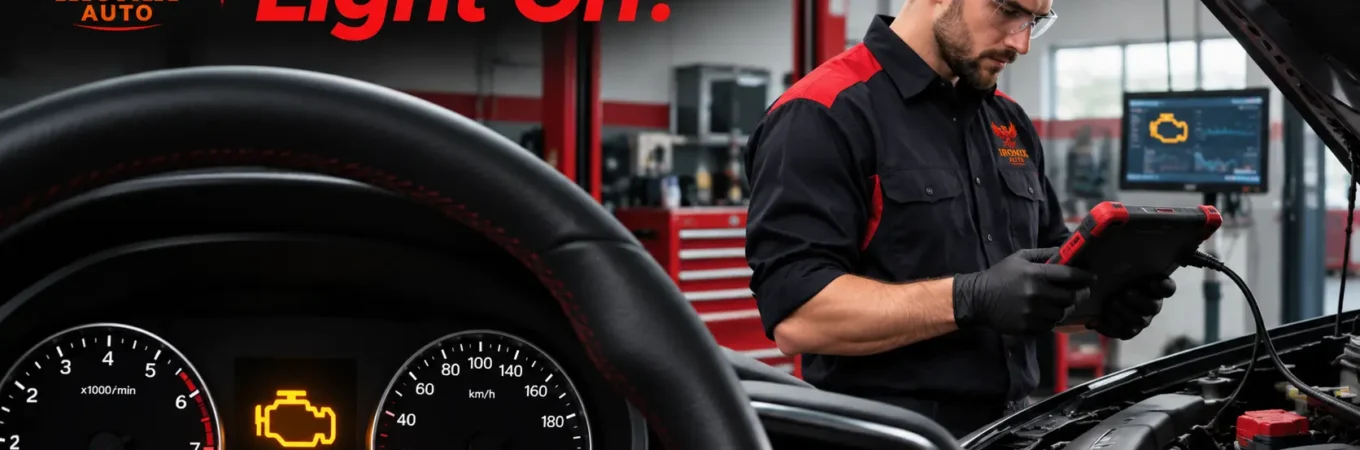
You’re driving through Kitchener when an unfamiliar yellow engine-shaped light appears on your dashboard. The car might still be running perfectly normally. Or perhaps you’ve noticed a rough idle, a slight hesitation when accelerating, or that your fuel tank seems to empty faster than usual.
The first question is usually, “Is this serious?” The second is, “Can I keep driving, or do I need a mechanic right away?”
A check engine light can mean anything from a loose fuel cap to an engine misfire that could damage your catalytic converter. The warning itself doesn’t tell you which part has failed. It tells you that the vehicle’s onboard diagnostic system has detected something that needs attention.
For drivers in Kitchener, Waterloo, and Cambridge, knowing how to respond can help prevent an inconvenient warning from turning into a costly repair.
This guide covers ten established causes of a check engine light, how to recognize the more urgent symptoms, what professional engine diagnostics actually involve, and how to avoid paying for parts your vehicle might not need.
First, is it safe to drive with the check engine light on?
Before investigating the cause, look at how the warning light is behaving.
| What you’re seeing | What it could mean | What to do |
|---|---|---|
| Steady yellow engine light, car drives normally | An engine-management or emissions fault has been detected | Arrange a diagnostic appointment promptly |
| Steady light with rough running or reduced power | A potentially more serious engine or fuel-management fault | Reduce driving and get professional advice |
| Flashing check engine light | Often a significant misfire that could damage the catalytic converter | Pull over safely, shut off the engine, and arrange assistance |
| Engine light with overheating, low oil pressure, smoke, or severe shaking | Potential engine damage or unsafe operating conditions | Stop as soon as safely possible and seek roadside assistance |
AAA distinguishes between a steady check engine light, which generally calls for timely diagnosis, and a flashing light, which can indicate a serious misfire. Bosch Car Service similarly recommends stopping safely and arranging recovery for a flashing warning.
The important point: A car that feels normal can still have a fault worth investigating. A flashing light, overheating, low oil pressure, or serious drivability problem should never be dismissed because the vehicle is still moving.
10 common causes of a check engine light
These are ten well-established possible causes, not a ranking of the most frequent repairs performed in Kitchener. Only a proper diagnosis can establish what is wrong with your particular vehicle.
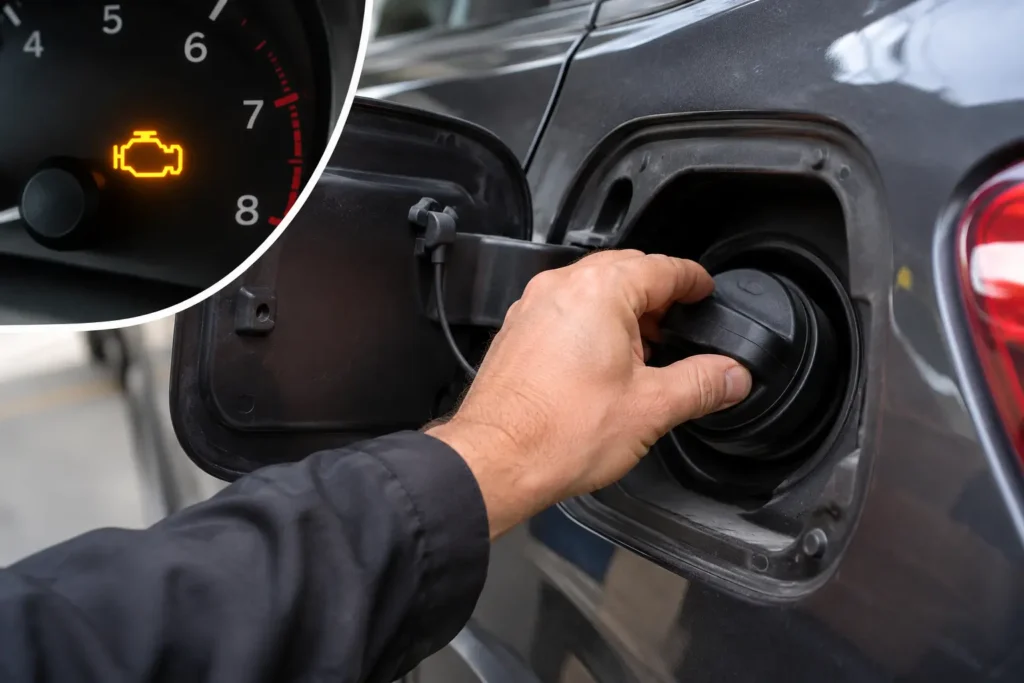
1. Loose or damaged gas cap
Typical clues: Light appears after refuelling; car otherwise runs normally
This is one of the simplest possibilities to check.
Your vehicle’s evaporative emissions system, often called EVAP, is designed to prevent fuel vapours from escaping into the atmosphere. On vehicles equipped with a conventional fuel cap, a loose, cracked, or incorrectly fitted cap can prevent the system from sealing correctly.
The vehicle’s computer may detect a leak and turn on the check engine light.
If the warning appeared shortly after you filled up, safely park, switch off the engine, and check that the gas cap is fitted correctly. Follow the cap’s closing instructions. Some newer vehicles have capless fuel systems, so this check will not apply to every car.
If a loose cap was the issue, the warning may take several driving cycles to disappear. If it stays on, the problem may involve another EVAP component.
What you should know: Don’t purchase a new gas cap just because your scanner reports an EVAP leak. Hoses, valves, seals, and other components can cause similar faults.
AAA identifies loose or defective fuel caps as an established cause of check engine warnings.
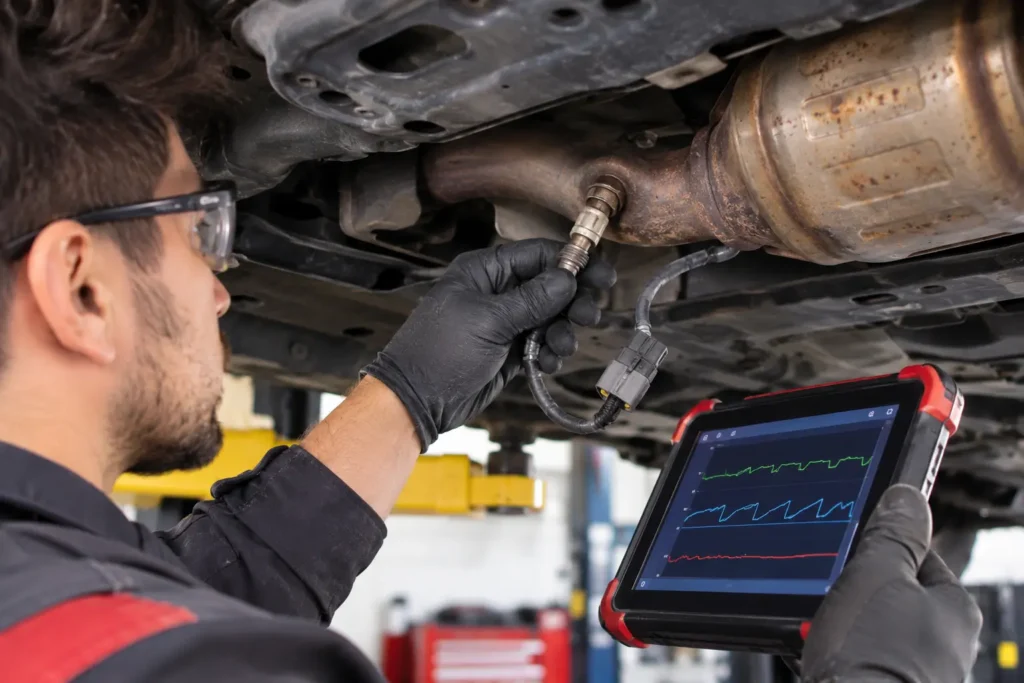
2. Failing oxygen sensor
Typical clues: Reduced fuel economy, emissions-related fault codes, sometimes poor performance
Oxygen sensors monitor oxygen content in the exhaust. Depending on their position and the vehicle’s design, their readings help the engine computer manage fuel delivery or monitor catalytic converter efficiency.
When a sensor becomes faulty, the computer may receive inaccurate information. You might notice increased fuel consumption, but some drivers notice no change at all.
An oxygen sensor fault can also be caused or influenced by issues elsewhere in the engine or exhaust system. An exhaust leak, wiring problem, or incorrect air-fuel mixture may produce readings that suggest a sensor problem even when the sensor itself is working.
This is why reading a code such as P0130 does not automatically justify ordering an oxygen sensor. A technician may need to inspect wiring, exhaust condition, sensor activity, and live engine data before recommending replacement. AAA explains the oxygen sensor’s role in fuel management and emissions control.
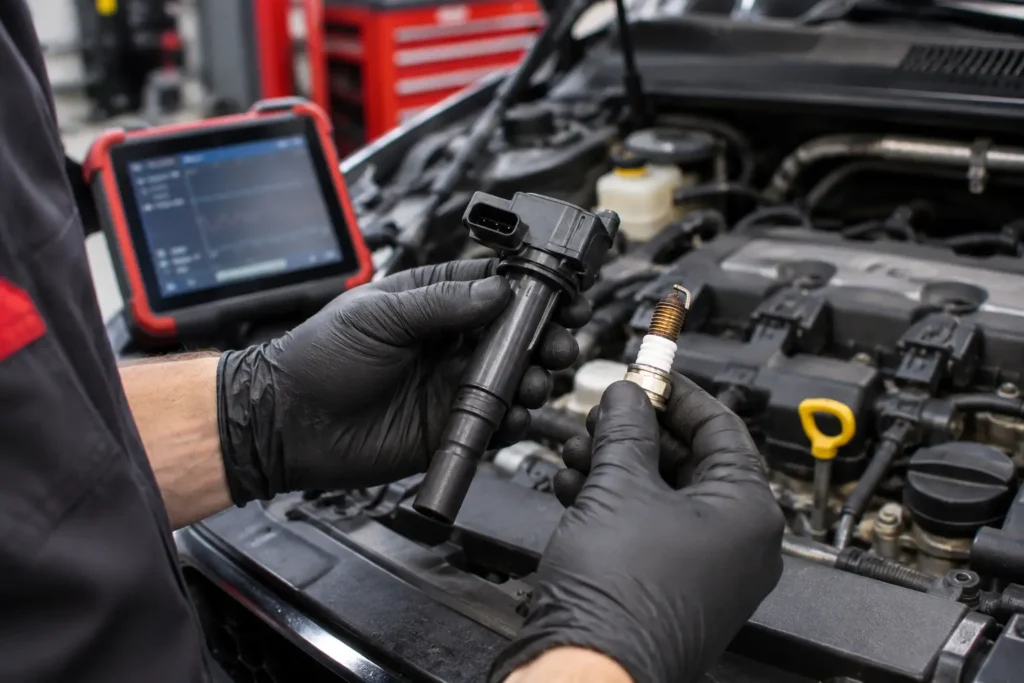
3. Worn spark plugs or faulty ignition coils
Typical clues: Rough idle, shaking, hesitation, misfire, flashing engine light
Spark plugs ignite the air-fuel mixture in a gasoline engine. Ignition coils provide the high voltage needed to produce that spark.
When a spark plug becomes worn, fouled, or damaged—or when an ignition coil fails—the affected cylinder may not burn its fuel mixture properly. This is called a misfire. You might notice the engine shaking at a stoplight, hesitating when accelerating onto Highway 7/8, or lacking its usual power.
A diagnostic scanner may show a code such as P0301, indicating a misfire associated with cylinder one. But that doesn’t prove the spark plug is responsible. An ignition coil, fuel injector, wiring fault, compression problem, or another condition could cause the same symptom.
NGK, a major spark plug manufacturer, identifies worn ignition components, damaged plugs, incorrect gaps, and insufficient ignition voltage as possible causes of misfires.
If the check engine light is flashing and the engine is shaking, stop safely and arrange assistance. Continuing to drive with a serious misfire may damage the catalytic converter. For suspected ignition problems, professional testing should come before spark plug or coil replacement.
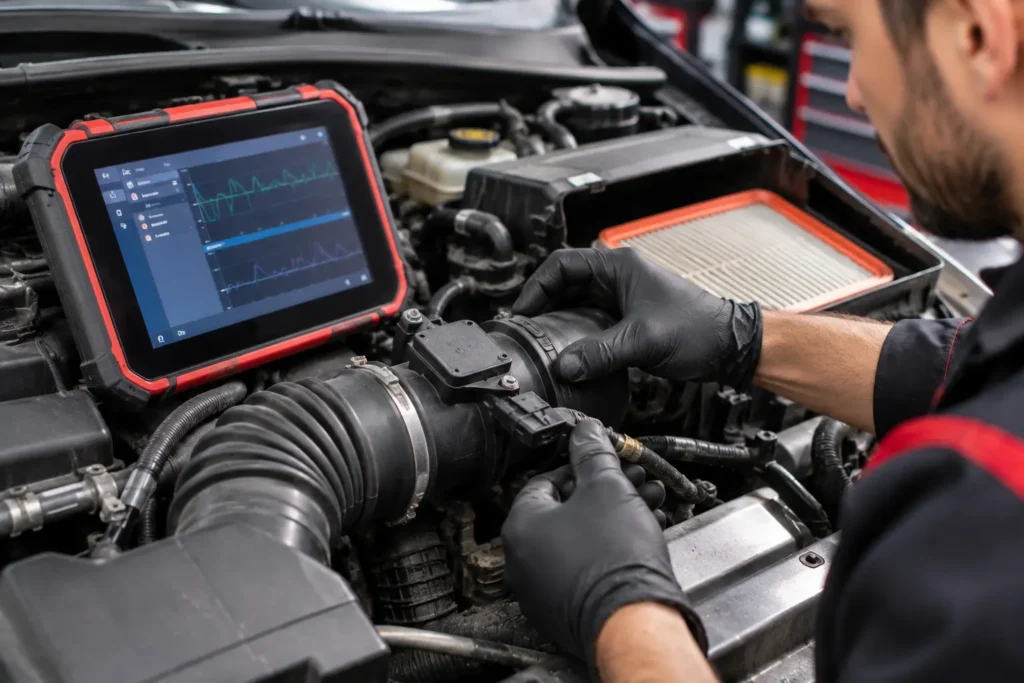
4. Faulty mass airflow sensor
Typical clues: Hesitation, rough idle, poor acceleration, increased fuel use
Your engine needs the correct balance of air and fuel to operate efficiently. On vehicles equipped with a mass airflow sensor (MAF), this component measures incoming air so the engine computer can calculate appropriate fuel delivery.
If the sensor becomes contaminated or faulty, the computer may receive incorrect airflow information. The result can be hesitation when accelerating, unstable idling, poor performance, or reduced fuel efficiency.
However, symptoms that suggest a MAF problem can also come from an air intake leak, wiring fault, fuel delivery issue, or another sensor. A mechanic may examine fuel-trim readings, sensor measurements, air intake components, and related fault codes.
Sometimes a sensor can be cleaned using an appropriate procedure and product; in other cases, replacement is necessary. Cleaning or replacing a sensor without confirming the fault may waste money.
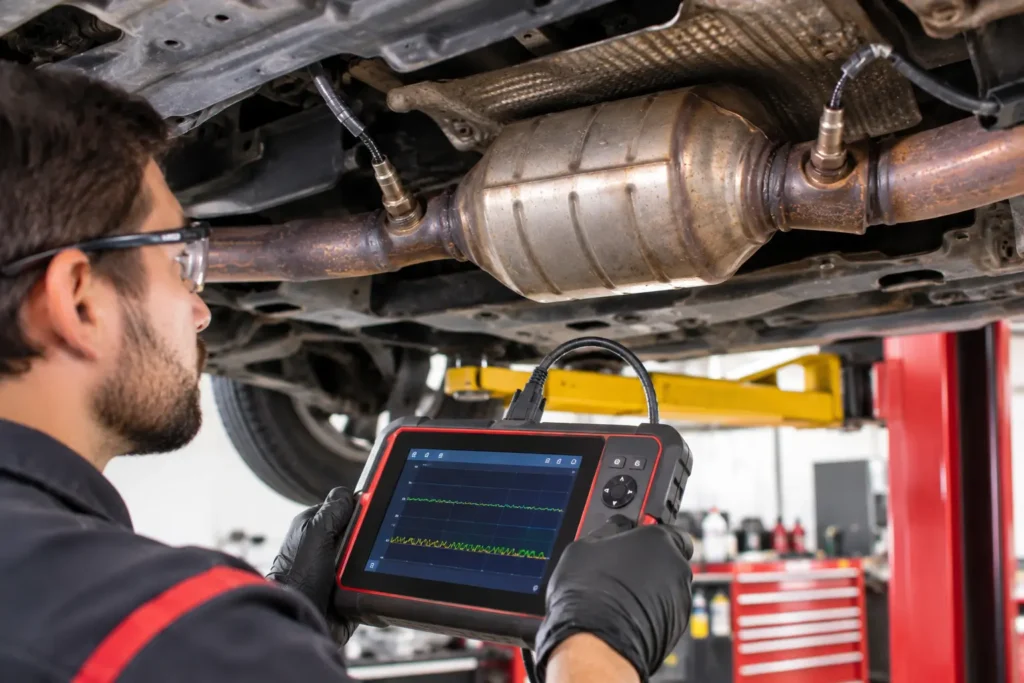
5. Catalytic converter problems
Typical clues: Persistent engine light, reduced power or fuel economy, emissions-related codes
The catalytic converter is part of the exhaust emissions system. It helps convert harmful exhaust pollutants into less harmful substances.
A damaged or inefficient converter can cause a check engine light, sometimes accompanied by poor acceleration or increased fuel consumption.
A code such as P0420 may indicate that the catalyst system’s efficiency is below the expected threshold. But here’s where diagnosis matters.
P0420 is not proof that the catalytic converter needs replacement.
Exhaust leaks, oxygen sensor problems, incorrect fuel mixtures, or previous misfires may affect catalyst monitoring. A technician should investigate those possibilities and determine whether the converter is actually faulty.
This matters because catalytic converters can be expensive to replace. More importantly, installing a new converter without correcting an underlying misfire or fuel-control problem can result in the new part being damaged too.
6. Fuel injector or fuel delivery problems
Typical clues: Hard starting, hesitation, rough idle, misfire, reduced engine power
Your engine relies on precisely controlled fuel delivery.
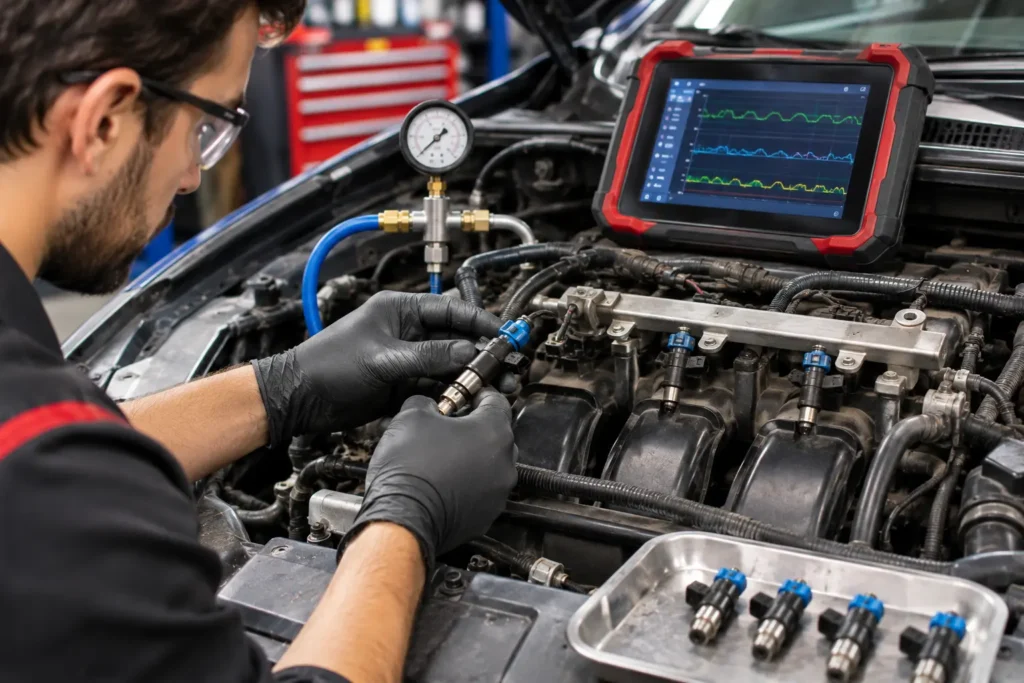
Fuel injectors supply fuel to the engine. If an injector becomes restricted, leaks, or stops operating correctly, combustion may be affected.
Fuel pressure problems can also lead to poor running or insufficient fuel delivery. Possible symptoms include difficult starting, hesitation, rough idling, reduced power, or an engine that runs unevenly. These symptoms overlap with ignition and airflow problems, so guessing is unreliable.
A proper diagnostic process may include fuel pressure checks, injector electrical testing, fuel-trim analysis, and examination of stored misfire or fuel-system codes.
The repair could involve an injector, wiring, fuel pump, pressure-control component, or another part of the fuel system. The important distinction is between identifying a fuel delivery problem and identifying the specific component responsible. Replacing injectors without confirming the problem is not a dependable repair strategy.
7. EVAP purge valve or vapour-system leak
Typical clues: Engine light with no obvious symptoms, sometimes hard starting after refuelling
A loose fuel cap is only one possible problem in the EVAP system.
The system also includes vapour lines, valves, a charcoal canister, and other components that manage fuel vapours.
A purge valve that sticks open or closed can cause an emissions-related fault. On some vehicles, a stuck-open purge valve can also contribute to difficult starting after refuelling.
EVAP faults are an example of why the dashboard warning doesn’t necessarily mean your engine is mechanically damaged. But the car may appear to run normally.
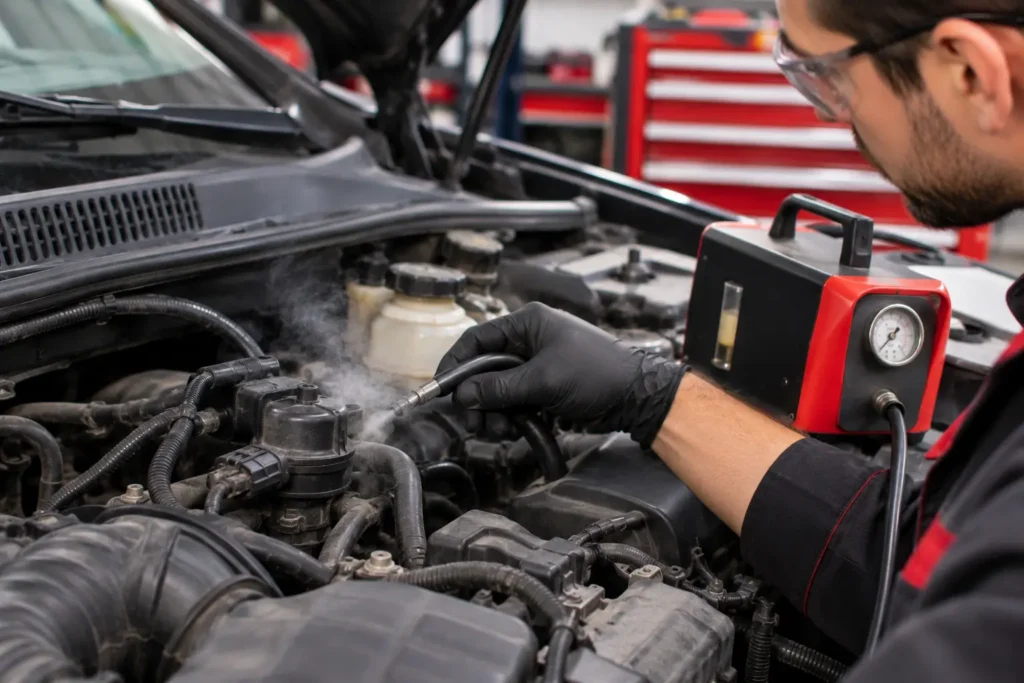
A technician can use diagnostic information and appropriate system tests, which may include an EVAP smoke test, to locate a leak or confirm valve operation.
If the warning appears repeatedly after filling the tank, mention that detail when booking diagnostics. It can help narrow the investigation.
8. Engine coolant temperature sensor or thermostat problem
Typical clues: Temperature-related codes, engine warming unusually slowly, heating or fuel economy changes
Your engine is designed to operate within a specified temperature range.
The thermostat regulates coolant flow, while the engine coolant temperature sensor tells the engine computer how hot the coolant is.
If the thermostat sticks open, the engine may take too long to reach its normal operating temperature. On some vehicles, that can trigger a code such as P0128. A faulty temperature sensor or associated wiring can also produce incorrect readings.
This issue deserves attention during Ontario’s colder months, when a vehicle already needs longer to warm up. However, cold weather itself does not establish that the thermostat has failed.
A technician can compare temperature readings, inspect cooling system operation, and check the manufacturer’s specifications.
Important: If your engine is genuinely overheating, the temperature warning is in the danger zone, or steam is visible, stop safely and switch the engine off. Do not remove a hot radiator cap.
9. Vacuum leaks or air intake problems
Typical clues: Rough idle, fluctuating RPM, hesitation, lean-mixture codes
Modern gasoline engines rely on controlled airflow.
A cracked intake hose, leaking gasket, damaged vacuum line, or certain crankcase ventilation faults can allow air to enter where it is not properly measured or accounted for.
The engine computer may then struggle to maintain the intended air-fuel mixture. You may notice rough idling, hesitation, or a check engine light with a lean-condition code such as P0171.
This is another situation in which blindly replacing an oxygen sensor can lead to an unnecessary expense. The sensor may be correctly reporting that the mixture is too lean.
A technician may inspect the air intake, examine fuel trims, check hoses and connections, and conduct a suitable leak test.
Sometimes the repair is a hose or gasket. Sometimes further investigation is needed. A correct repair depends on locating the actual source of unmetered air.
10. Battery, alternator, or electrical voltage problems
Typical clues: Slow starting, dim lights, multiple electrical warnings, intermittent faults
A weak battery or charging-system problem can sometimes contribute to engine-management faults or abnormal sensor and module behaviour.
This doesn’t mean every check engine light is caused by the battery.
A dedicated battery or charging-system warning light usually indicates a different issue, and a check engine light alone is not enough evidence to replace a battery.
However, electrical supply matters because modern vehicles depend on stable voltage for engine computers, sensors, ignition, and fuel-management systems.
In colder Ontario weather, existing battery weaknesses can become more noticeable during starting.
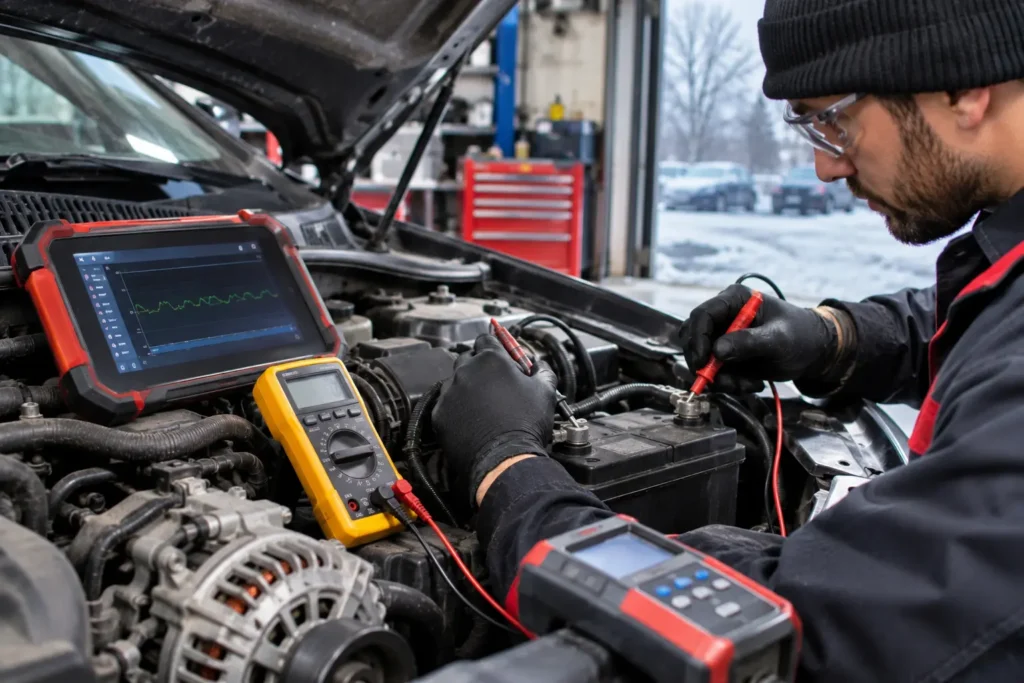
If your engine cranks slowly, electrical systems behave unpredictably, or multiple warning lights appear, checking battery condition, alternator output, cables, and connections may be appropriate.
Ironix Auto offers battery and charging-system testing as part of its published services. You can learn more on its Battery Repair and Replacement page.
Why a diagnostic scan doesn’t always tell you which part to replace
One of the most expensive mistakes drivers make is assuming a fault code identifies a failed part.
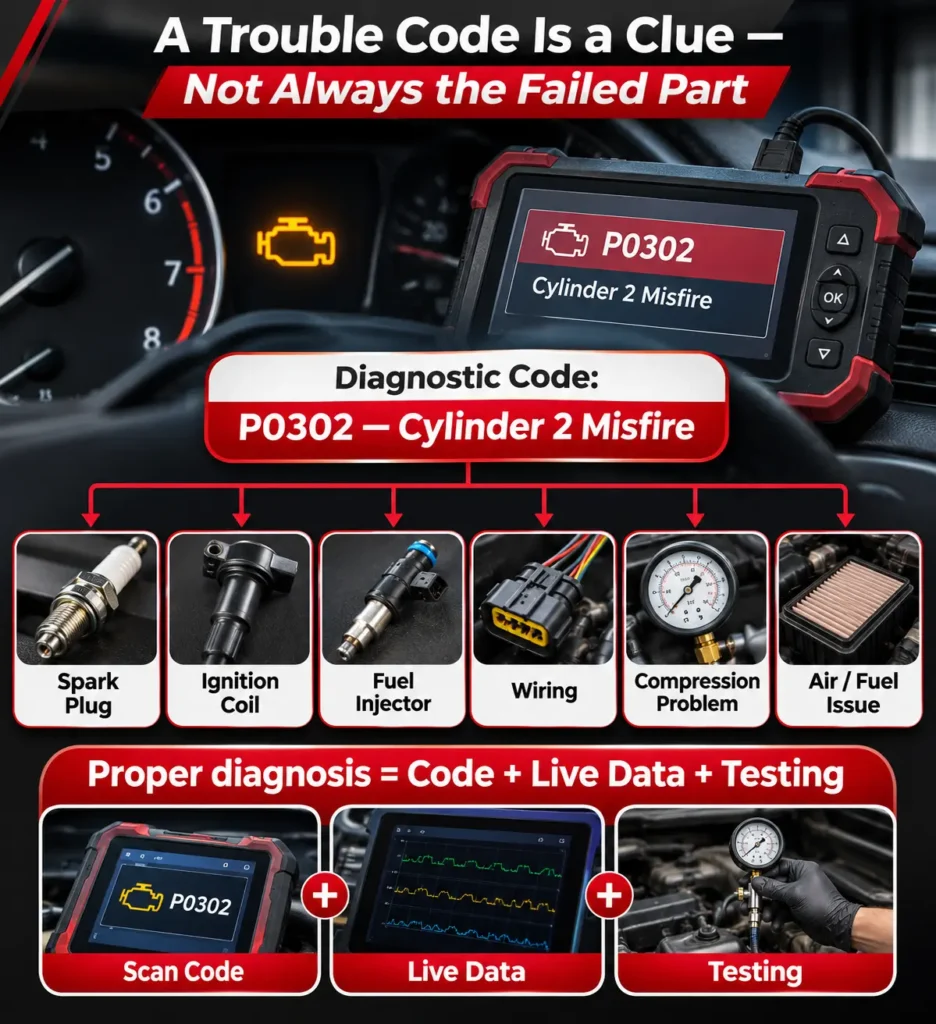
For example, suppose your scanner shows P0302. That tells you the engine computer has detected a misfire associated with cylinder two. It doesn’t tell you whether the problem is a spark plug, ignition coil, injector, wiring, or mechanical fault.
A proper diagnostic appointment may involve reading stored and pending codes, examining freeze-frame data (the vehicle conditions recorded when a fault was detected), reviewing live sensor information, and performing targeted tests.
Once the actual fault has been identified, the technician can recommend a repair and verify the result afterward.
Bosch Car Service explains why combining diagnostic codes with live data, wiring checks, and component testing is more reliable than simply replacing parts suggested by a scanner.
How much does check engine light diagnosis cost in Kitchener?
There isn’t one fixed price for every check engine light diagnosis.
A straightforward issue that can be confirmed quickly may require relatively little testing. An intermittent electrical fault or misfire that only occurs under certain conditions may take considerably longer.
When calling a repair shop, ask whether the quoted fee covers an initial code scan, actual diagnostic testing, or both. Also ask whether additional testing requires your approval.
The repair itself should be quoted separately. A loose connection, spark plug replacement, fuel injector repair, or catalytic converter replacement will not have the same cost.
A useful question to ask is:
“Will the diagnostic fee help identify the cause, or am I only paying to read the stored codes?”
Can cold Ontario weather cause a check engine light?
Cold weather can contribute to conditions that reveal existing vehicle problems, particularly weak batteries, electrical faults, and some engine operating issues.
Short winter trips may also mean the engine spends more time warming up.
But freezing temperatures are not, by themselves, a diagnosis. If the warning appears every winter, the stored fault information and operating conditions should be investigated.
Likewise, if the light appears shortly after refuelling, checking the fuel cap may be reasonable, but you shouldn’t assume that’s the answer without evidence.
Should you reset the check engine light yourself?
Avoid clearing the light before recording the diagnostic information.
Resetting the warning does not repair the fault. It may also erase stored information that helps a technician understand what happened.
If a problem is still present, the warning may return after the vehicle performs its monitoring tests.
A better approach is to record when the light appeared, whether it flashed, what the car was doing, and any symptoms you noticed.
Where to book check engine light diagnostics in Kitchener
If you’re searching for engine diagnostics near me or need help with a check engine light in Kitchener, Ironix Auto provides computerized engine diagnostics and mechanical repair services.
According to its published service information, Ironix Auto’s diagnostic process involves a scan, mechanical inspection, explanation of the problem, repair or replacement where necessary, and testing.
If your check engine light is on, book an engine diagnostic appointment rather than guessing which component needs replacing.
Frequently asked questions
Can I drive with a steady check engine light?
If the light is steady and your vehicle is running normally, a short necessary journey may be possible, but arrange diagnosis promptly. If the vehicle is shaking, overheating, losing power, or showing other serious symptoms, stop safely and seek assistance.
Why is my check engine light on when the car drives fine?
Some emissions-related faults cause little or no noticeable change in performance. A loose fuel cap, EVAP leak, or sensor-related problem may trigger a light before you notice drivability symptoms.
What does a flashing check engine light mean?
It commonly indicates a serious misfire that could damage the catalytic converter. Pull over safely, switch off the engine, and arrange professional assistance rather than continuing to drive.
Will a check engine light turn off by itself?
Sometimes. If the underlying fault is no longer present, the warning may turn off after the vehicle completes the required monitoring cycles. That does not prove every problem has been permanently resolved.
Can bad spark plugs cause the check engine light to come on?
Yes. Worn, damaged, or fouled spark plugs can cause misfires and trigger the warning. However, ignition coils, injectors, wiring, and other faults can produce similar codes, so testing matters.
Is a check engine light the same as an oil change reminder?
No. A check engine light generally relates to engine-management or emissions-related faults. A routine oil change reminder is a separate maintenance notification on most vehicles.
The bottom line
A check engine light doesn’t automatically mean a major engine repair. It also doesn’t mean the problem is harmless because the car still drives.
The sensible next step is to respond to the warning’s urgency, have the stored information checked, and confirm the fault before approving replacement parts.
If your light is flashing or the car is behaving abnormally, prioritize safety. If it is steady and the car drives normally, arrange a diagnostic appointment without unnecessary delay.
Check engine light on? Book professional engine diagnostics at Ironix Auto in Kitchener and find out what’s causing it.